

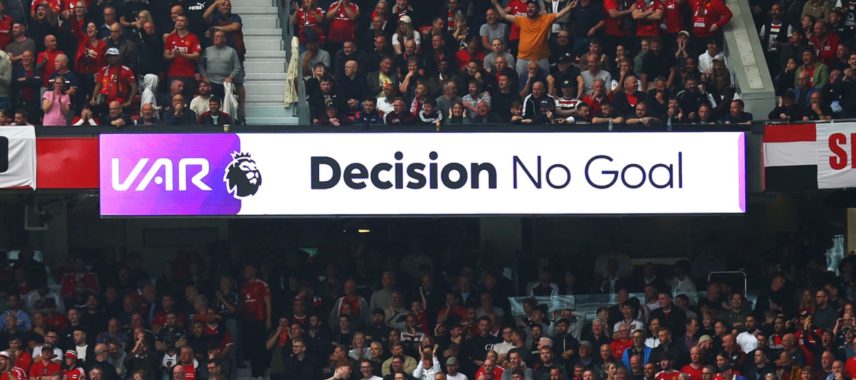
For centuries, football relied on the human eye, which could not keep up with the pace of events on the pitch. The Video Assistant Referee (VAR) has shifted this balance: the referee is now supported by a team that can view a controversial moment from a dozen different angles.
The English Premier League has become the most high-profile testing ground for this technology, and football itself has long since moved beyond the confines of a ninety-minute match. Fans watch live streams online, track statistics, discuss referees’ decisions on social media and use various digital services related to sporting entertainment.
In this environment, non gamstop casinos attract particular attention; they also target a British audience and offer an alternative form of online entertainment. Against this backdrop of diversity, VAR remains one of the most talked-about technologies, as every decision it makes directly influences the course of the game and the emotions of the spectators.
What is VAR and how did the technology find its way into top-flight football?
The abbreviation stands for Video Assistant Referee. Behind the acronym lies a team of specialists who work not on the pitch, but in a control room with access to all the stadium’s CCTV cameras. The rationale behind the tool’s introduction was straightforward: serious errors in key moments were rare, but they cost clubs titles and tens of millions of pounds.
The Dutch were the first to conduct a systematic trial back in the early 2010s. Their findings formed the basis of a protocol which the IFAB initially allowed to be trialled, before incorporating it into the laws of the game in 2018.
British football held back for a long time: the Premier League only joined in the 2019/20 season. A centralised operations centre at Stockley Park serves all the league’s matches simultaneously, which sets the English model apart from the rest of Europe.
How the video team operates during a match
Each match is supported by a team of several people: the lead assistant communicates with the pitch, an assistant monitors parallel incidents, and the replay operator searches for the right angle. The system operates in the background – spectators only become aware of a review when something has gone wrong.
The protocol clearly limits the scope of video refereeing to four categories:
- goals and the fouls leading up to them;
- the awarding or overturning of a penalty;
- a straight red card;
- incorrect identification of a player who has been shown a card.
What happens at the monitor
When an assistant spots a potential error, they recommend a review. The referee runs to the screen by the touchline and makes the final decision personally. It is precisely this detail that gives rise to the lion’s share of misunderstandings: many fans still believe that the decision is made by the system.
Semi-automatic offside: when an algorithm draws the line
Offside situations have traditionally caused the longest delays: an operator would manually search for the frame showing the ball being touched, then superimpose virtual lines onto the players’ bodies.
Semi-automatic offside technology (SAOT) has eliminated this work – ceiling-mounted cameras track dozens of points on each player’s body and the ball’s trajectory, after which the algorithm itself determines the moment of the pass. The Premier League launched the system in the spring of 2025 and saves around 27 seconds per incident.
The term ‘semi-automatic’ is no accident here. The machine suggests a result, whilst a human confirms the accuracy of the recognition. Where offside calls require interpretation – such as deliberate play by a defender or influencing an opponent without touching the ball – the final decision still rests with the refereeing team.
The English Premier League: a high threshold for intervention
The British league has deliberately opted for a minimalist approach. Its annual ‘football principles’ invariably set a high threshold for reviewing incidents: a decision made on the pitch remains valid unless the evidence points to a clear and obvious error.
This policy has a downside. Fans compare similar incidents from different matchdays and cannot see the logic behind why, in one instance, the referee was called to the monitor, whilst in another, they were not. From the 2025/26 season, referees began announcing the results of reviews over the stadium PA system, except in cases of clear-cut offside – a practice previously trialled in cup competitions.
Why the controversy surrounding video replays shows no sign of abating
The presence of technology in top-flight football has not made it any more popular. Most complaints concern not the idea itself, but its implementation:
- the emotional lull after a goal is scored – the crowd’s joy freezes for a moment;
- the perception of double standards between leagues;
- ‘under-the-arm’ offsides, where the margin is measured in centimetres;
- the secrecy of communications between the pitch and the control room.
The last point is the most contentious: the league and PGMOL are lobbying IFAB for access to live audio, as has long been the practice in rugby and American sports.
What’s changing in the 2026/27 season
The latest set of guidelines continues the trend towards restraint. The list of grounds for review has been expanded in specific areas – it is now possible to review a second booking that led to a sending-off. However, the English have abandoned an optional rule trialled at the 2026 World Cup: a wrongly awarded corner will not be overturned here, so as not to cause further stoppages.
Video assistant refereeing has not made football fair in a philosophical sense – it has merely shifted the debate from ‘the referee didn’t see it’ to ‘the referee saw it and decided otherwise’.
The final say still rests with the man with the whistle, and it is precisely in this paradox that the reason lies as to why the controversies will not subside.